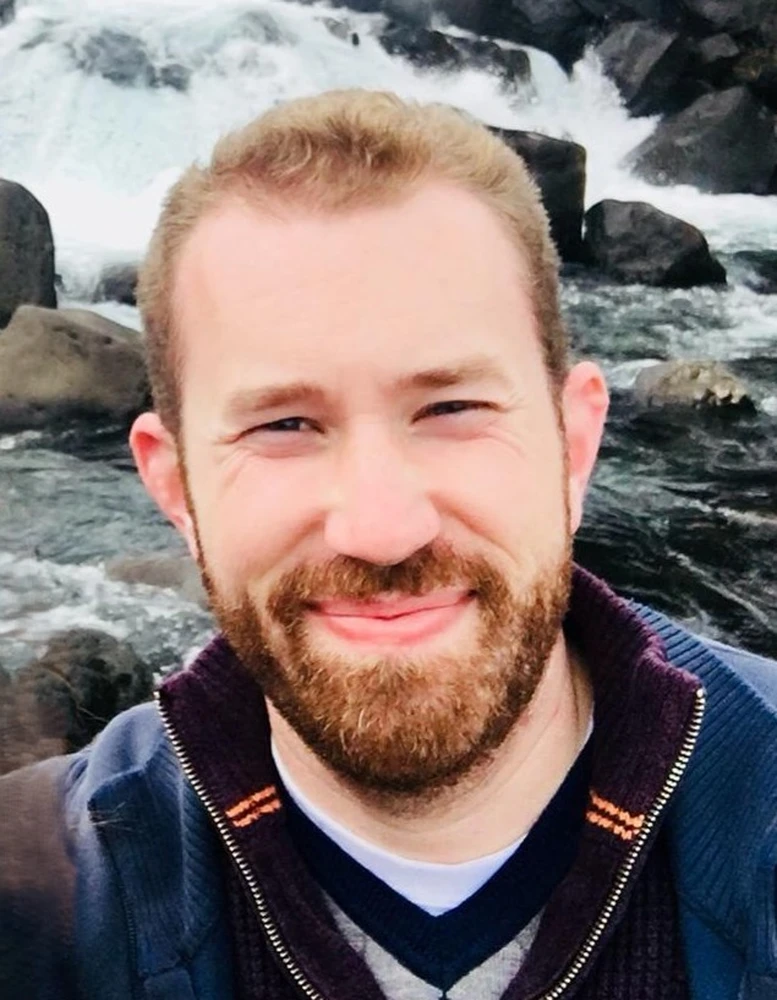

Jordan McAlister is a human geographer with interests in the built environment, historical geography, and historic preservation. A native of Texas, he has long taken an interest in the cultural and regional geographies of North America, including the Great Plains, the Rocky Mountains, the Prairie Provinces, the American Southeast, and the Midwest. He has a passion for places, life-long learning, and travel, and loves discussing the world with students and those interested in geography. His research focuses on the preservation of civic architecture, New Deal artwork, and the role human landscapes play in conceptions of place.
Jordan recently joined the Department of Geography & Geographic Information Science at the University of Illinois Urbana-Champaign as a professor and an undergraduate advisor. We recently caught up with Jordan about why he’s excited to join the department and what he’s most looking forward to.
What drew you to a teaching-focused career in geography, and what excites you most about working with undergraduates?
I have long enjoyed learning about the world, and at an early age, I discovered an unending love of travel, history, and places. I was painfully shy as a young man, but when given the opportunity to teach geography as an undergraduate TA, I discovered my passion for explaining the world to others. I found my voice, and my travels and curiosity proved to be an asset for teaching. I have loved education ever since, and to me, there is nothing else so enriching and important in my career. I love working with undergraduates because so much of the world is new to them, especially for geography topics outside of North America. It is truly a gift to be able to usher young minds through the societies and cultures of our planet.
How do your interests in historical geography and the built environment shape the way you approach teaching in the classroom?
As a historical geographer, I seek to explain how the conditions of the world, geopolitics, and cultural attitudes came to be. That means contextualizing a fair amount of recent historical events, especially since the 18th century. I tell my students that sometimes a geography course with me feels a bit like a history class. However, geography is my discipline and true passion. Therefore, understanding how history impacts place is the key. In my undergraduate classes, my students should conclude a semester with me knowing at least a little bit about everywhere. The built environment is a topic that relates to almost every cultural lecture I conduct. The human landscape is often the most visible element that helps us understand cities, cultures, religions, power, and history. Identifying the elements of the built environment is, therefore, a favorite tool of mine for explaining these phenomena; I typically use my sizable personal photo archive to help illustrate these elements.
What do you hope students take away from your courses?
I tell students that I hope they take from my class a general foundation for understanding the world that will stick with them for a lifetime. A foundation upon which can be built an understanding, tolerance, and acceptance of the amazing diversity and richness of our planet and its peoples. I encourage them to be curious and to pursue a lifetime of learning. I typically try to encourage travel for the sake of inspiration and education as much as I can. If they leave my class inspired to see more of the world, I am satisfied that I have accomplished something important.
As an undergraduate advisor, how do you like to support students as they explore majors, careers, or paths they may not have considered yet?
I like helping students better understand what they may want to do after graduation. Many of our students in GGIS come to the discipline after taking a course or two that interested them, as opposed to beginning their academic career with a declared GGIS major. Therefore, their future employment might be uncertain. I like being able to talk about their personal passions and connect those to future career opportunities in geography, government, planning, consulting, industry, or academia.
What are you most looking forward to about joining the Geography & GIS community at Illinois this spring?
I love the students at Illinois. Having taught for a semester in 2024, I know that the pupils here are gifted, respectful, and engaged. The students here are my priority, and they motivate me at every turn. They give me their best, and inspire me to give them my best.