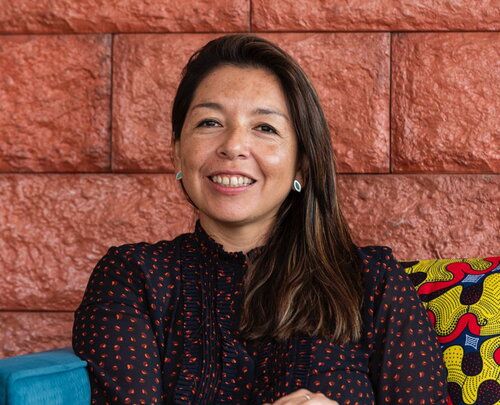
Biography
Sofía Zaragocín is Associate Professor of Geography and Geographic Information Science and Acting Director of the Center for Latin American and Caribbean Studies at the University of Illinois Urbana-Champaign. Originally from Quito, Ecuador, and raised in Philadelphia, she has lived and worked across Latin America and the United States, an experience that informs her transnational and hemispheric approach to geography.
Prior to joining UIUC, Zaragocín was Associate Professor at Universidad San Francisco de Quito (USFQ), where she also served as Co-Director of the Institute of Inequalities. Before her academic career, she worked for nearly a decade in international policy, including with the United Nations.
Her professional experience also includes longstanding collaboration with academic and community-based networks in Latin America. She has been a member of the Critical Geography Collective of Ecuador and was a co-founder of Re-Existencia Cimarrunas. These experiences contribute to her collaborative approach to research and geographical knowledge production across institutional and regional contexts.
Research Description
Her research examines the intersections of gender, territory, environmental change, and geographical knowledge in Latin America and the Americas. Grounded in long-term collaborative research in Ecuador and across Latin America, her work addresses gender-based violence, resource extraction, conservation, climate change, and socio-environmental change.
A particular focus of her scholarship is feminist and decolonial geographical methodology. She is interested in collaborative and situated approaches to research, including the relationships between academic and community-based knowledge and the ways geographical knowledge is produced across different institutional, cultural, and territorial contexts.
Her current research in the Galápagos Islands examines conservation and climate change through feminist and island geographies. Across her work, she brings Latin American and Latinx feminist geography into conversation with Black, Indigenous, and decolonial geographical scholarship and develops hemispheric perspectives that connect geographical debates across Latin America and the United States.
Education
Ph.D., University of Cambridge
M.Phil., University of Cambridge
M.A., FLACSO Ecuador
B.A., University of Pennsylvania
Grants
2024–2026 — Arts-Based Approaches to Gender-Based and Racialised Violence in Esmeraldas, Ecuador. Arts and Humanities Research Council (AHRC), UK Research and Innovation.
2023–2025 — Geographies of Indigenous Citizenship in Latin America. Leverhulme Trust / University of Cambridge.
2022–2026 — Individual, Organizational and Transnational Strategies in Response to the Intersectional Continuum of Violence. Université Laval.
2022 — Feminist Geography Conference: Pushing Scientific Boundaries. National Science Foundation (NSF).
2020–2023 — Political Ecology, Island Feminism and Gender-Based Violence in the Galápagos Islands. Universidad San Francisco de Quito.
2019–2023 — Harnessing Afro-Ecuadorian Women’s Heritage to Promote Peaceful and Equitable Development in Esmeraldas, Ecuador. British Academy / Northumbria University.
2011–2016 — Universities of Excellence Grant Programme. Government of Ecuador.
Awards and Honors
2026-2027. Helen Corley Petit Scholar at the University of Illinois Urbana Champaign
2024. Ecuadorian Secretary of Education, Science and Technology prize for outstanding scholar in the Arts and Humanities.
2022. Awarded the Paul Lazarsfeld Professorship, Vienna Doctoral School of Social Sciences.
Courses Taught
GGIS-496 Climate & Social Vulnerability
GGIS-495 Feminist Geographies
GGIS-466 Enviornmental Policy
Additional Campus Affiliations
Acting Director of the Center for Latin American Studies
Advisory Board for the Unit for Criticism & Interpretive Theory
Recent Publications
Journal Articles and Special Issues
2026
Zaragocín, S., Armijos Bueno, T., Cupuerán Yánez, M. I., Sevilla, E., & Zambrano Rojas, A. P. “Methodologies of Intersectionality for Disaster Risk Studies.” Disaster Prevention and Management: An International Journal.
Zaragocín, S., & Bayón, M. “Hemispheric Revanchist Masculinity.” Dialogues in Urban Research.
Caretta, M. A., Ramasar, V., Zaragocín, S., & Torres, K. “Cuerpo-Territorio: Lessons Learnt on a Method to Study Embodied Emotions.” International Journal of Qualitative Methods.
2025
Zaragocín, S. “Embodied Reflections on Return Migration across the Americas.” Journal of Latin American Geography.
2024
Zaragocín, S. “Agua-Cuerpo-Territorio/Water-Body-Territory.” Political Geography.
Caretta, M., Côte, M., Ramasar, V., Nair van Ryneveld, T., & Zaragocín, S. “Water and Gendered Embodied Resistance to Extractivism: A Systematic Scoping Review.” Geography Compass.
Perera, I., Shahrokni, N., Gqola, P., Phadke, S., & Zaragocín, S. “Gender and Public Space.” Special Issue. Gender & Development.
Zaragocín, S. “Commentary to the Joint Plenary: Black Geographies Specialty Group, Cultural Geographies, and Political Geography on the Work of Repair: Land, Relation and Pedagogy.” Cultural Geographies.
Boudewijn, I., Jenkins, K., Zaragocín, S., & Bone, J. “Afro-Ecuadorian Women, Territory, and Natural Resource Extraction in Esmeraldas.” Progress in Development Studies.
Book Chapters
2026
Rodriguez, Y., & Zaragocín, S. “Doing Decolonial and Feminist Research across the Americas: A Dialogue on Exposure and Accountability to Mestizaje.” In V. Bates et al. (Eds.), Handbook of Health and Environmental Humanities. Routledge.
2025
Zaragocín, S. “Feminist Geographies.” In S. Halvorsen (Ed.), Latin America Geographies (1st ed., pp. 181–189). Taylor & Francis.
2024
Zaragocín, S. “Hemispheric Approach to Relational Anti-Racist Place Making.” In M. Daigle & H. Dorries (Eds.), Land Back: Indigenous Landscapes of Resurgence and Freedom. Harvard University Press.